



Prabowo defends criticism of media, says Indonesia still has a 'Londo Ireng' mentality
The President said he understood the intention behind such reporting but declined to identify the media outlet he was referring to.
news

The President said he understood the intention behind such reporting but declined to identify the media outlet he was referring to.
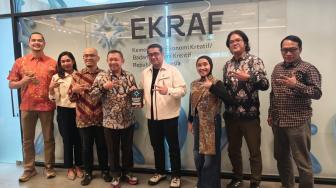
Riefky said local media could play a broader role than simply delivering news by helping regional creative industries expand their reach and competitiveness.
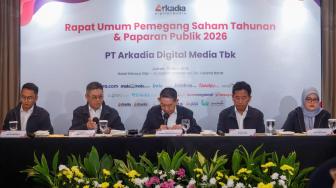
Based on the achievements and initiatives undertaken, Suwarjono said the Board of Directors remains optimistic about the Companys future prospects.
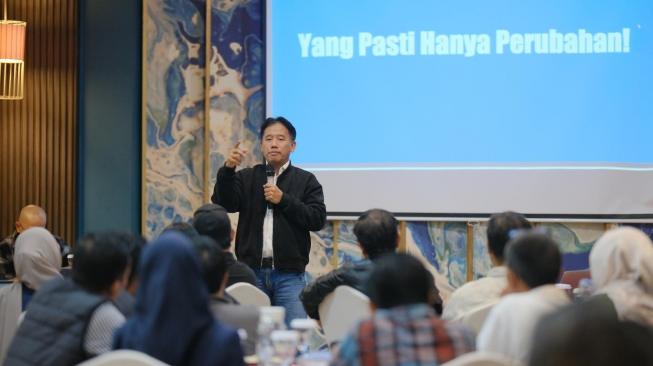
Indonesia’s digital media landscape stands at a critical crossroads in the third quarter of 2026. The rapid development of generative artificial intelligence (AI), changes to search engine architecture, shifts in how audiences access content, the impact of government efficiency measures on media businesses, and changing dynamics in the advertising market have pushed both conventional and digital news media business models to a critical point.
Meanwhile, the government, through the Ministry of Law of the Republic of Indonesia, has initiated the revision of Law No. 28 of 2014 on Copyright, including journalism among the areas entitled to economic rights. The move follows the enactment of Presidential Regulation No. 32 of 2024 on the Responsibilities of Digital Platform Companies to Support Quality Journalism (the Publisher Rights Regulation).
As part of its public responsibility and efforts to consolidate the voices of publishers outside the major media centres, the Local Media Community (LMC) — a collaborative network representing hundreds of local, small and medium-sized media outlets across Indonesia — would like to convey its views on the proposed regulation.
“These recommendations are formulated based on operational realities on the ground, as well as input gathered through a series of independent discussions recently organised by LMC with stakeholders across the press industry,” said Suwarjono, Editor-in-Chief of Suara.com and one of the initiators of the Local Media Community.
The LMC’s official position was developed following a series of discussion roadshows in Pekanbaru, representing Sumatra; Makassar, representing Eastern Indonesia; and Surabaya, representing Java. Participants included media representatives from Riau, the Riau Islands, Jambi, West Sumatra, South Sulawesi, West Sulawesi, Central Sulawesi, Southeast Sulawesi, East Java, Central Java, West Java, Yogyakarta and Bali.
The roadshows confirmed that local media are facing significant shifts in audience behaviour. Organic referral traffic from conventional search engines has fluctuated sharply, while Gen Z’s consumption of news and information is increasingly concentrated on short-form video platforms and social media such as TikTok, Instagram and YouTube.
At the same time, technology support programmes such as the Google News Initiative (GNI) have demonstrated their potential to improve media performance. For example, Project Sigma Indonesia: Gen Z & News, involving 10 newsrooms in Jakarta and Surabaya, recorded a 1.5-fold increase in young audiences. Meanwhile, the Revenue Growth Lab Indonesia programme, involving 12 publishers from Sumatra to East Nusa Tenggara, recorded an 18% increase in digital advertising revenue and 47% growth in user visits.
Although technological innovation offers opportunities to improve efficiency, rigid regulatory intervention, such as that initially proposed in the Copyright Bill, could create new obstacles that threaten the stability of local media businesses.
“From our discussions in three cities with around a hundred media leaders representing more than a dozen provinces, these concerns clearly emerged. While we are already dealing with challenges arising from changes in the media landscape, including audiences moving to social media, there is a concern that copyright regulation could inadvertently create additional difficulties,” said Suwarjono.
The revision of Law No. 28 of 2014 on Copyright has been proposed by the Ministry of Law as a structural intervention to provide legal certainty for journalistic products as objects of Intellectual Property Rights (IPR). As a matter of legal doctrine, copyright law treats pure facts (bare facts) as part of the public domain and therefore not subject to copyright, with legal protection applying only to the expression of factual information.
The proposed amendment seeks to expand this boundary by recognising “journalistic works” as a distinct legal entity. The draft introduces a dual-layer protection structure separating the moral rights and copyright of individual journalists from the economic rights transferred to media companies.
However, while the draft amendment could strengthen the legal position of journalistic works, LMC believes there is a fundamental mismatch between the regulatory assumptions and the operational realities of local media organisations.
Based on the consolidated views gathered during the three-city roadshow, LMC has formally submitted its recommendations and input to the government, particularly to the Director General of Intellectual Property at the Ministry of Law. LMC’s position focuses on five key areas of concern for local media operators.
1. Ambiguous Definition of Journalistic Works and Editorial Realities
One of the most fundamental weaknesses in the current discussion of the Copyright Bill is the absence of a clear and specific definition of “journalistic works”.
In the daily operations of local newsrooms, editorial teams typically consist of only five to ten people. These resource constraints mean that approximately 80% of local media’s daily output consists of government press releases, corporate statements or basic straight news reports. Only around 20% consists of investigative or in-depth reporting, independent research or added-value reporting based on local niche issues.
| Local Media Content Category | Estimated Share of Publications | Copyright Protection Implication |
| Generic Content & Public Information | ~80% of total publications | Should be excluded from copyright or royalty claims to prevent disputes. |
| In-depth & Original Reporting | ~20% of total publications | Should constitute the primary category eligible for copyright protection. |
If the law adopts an overly broad definition of journalistic works, raw press releases, compiled news reports and even clickbait articles could potentially be subject to unilateral copyright claims and compensation demands.
This could create legal uncertainty, trigger disputes between publishers and undermine the professional media ecosystem.
LMC therefore proposes that copyright and royalty protection should be strictly limited to original journalistic works that meet robust standards of factual verification and substantive reporting, while public information and official press releases should be excluded.
2. The Risk of Losing Content Distribution and Programmatic Advertising
In today’s digital ecosystem, the relationship between media organisations and global digital platforms is not simply about direct financial compensation. It is also about access to distribution infrastructure.
Local media organisations, with limited budgets for servers, IT infrastructure and marketing, rely heavily on indexing by search platforms and news aggregators to reach audiences at scale. If the Copyright Bill introduces rigid payment obligations that place excessive burdens on platforms, the greatest risk for local media would be the suspension or restriction of news distribution.
De-indexing by platforms could cause local media page views to fall dramatically. The knock-on effect would be the loss of revenue from programmatic advertising networks such as Google AdSense, which currently provide a major source of operating income for regional media organisations.
In other words, local media could theoretically gain a small amount of royalty compensation while losing the real advertising revenue that currently sustains their journalistic operations.
3. Strengthen Business-to-Business (B2B) Arrangements, Not Centralisation through LMKs
LMC firmly rejects the government’s proposal to manage and distribute royalties for journalistic works through Collective Management Organisations (LMK) and the National Collective Management Organisation (LMKN).
This position is informed by concerns over the track record of LMK governance in Indonesia’s music industry, including issues surrounding data transparency, high bureaucratic operating costs and delays in distributing funds.
| Evaluation Dimension | Centralised LMK Model | Pure B2B Negotiation | Hybrid Model (Press Council & AJI) |
| Governance Mechanism | Centralised collection and distribution through an LMK intermediary. | Direct licensing negotiations and contracts between publishers and platforms. | B2B for independent publishers, with voluntary collective options for smaller publishers. |
| Cash Flow | Slow; subject to annual bureaucratic audit cycles. | Fast; direct payment to media organisations according to agreed terms. | Flexible; adapted to the model chosen by each publisher. |
| Content Valuation Autonomy | Low; compensation values standardised by the LMK. | High; publishers determine the commercial value of their products. | Moderate; maintains bargaining power without eliminating autonomy. |
| Operational Risk | Could trigger platform resistance and news blocking. | Encourages adaptive and sustainable commercial partnerships. | Avoids an LMK monopoly while facilitating access for smaller media. |
The fast-moving nature of the digital news industry requires flexible daily cash flow. Adding an LMK bureaucratic layer could place additional pressure on the finances of local media organisations.
Instead, LMC supports a pure Business-to-Business (B2B) model, or the Hybrid Model — the “Third Way” proposed by the Press Council and the Alliance of Independent Journalists (AJI).
A B2B model gives media companies greater freedom to negotiate directly with digital platforms based on the commercial value of their products. This is consistent with the spirit of Presidential Regulation No. 32 of 2024, which emphasises paid licensing or revenue-sharing arrangements based on contractual agreements.
4. The Impact of a Link Tax on the Principle of an Open Internet
LMC also strongly rejects proposals to introduce a “link tax” that would impose payment obligations for the use of hyperlinks and short snippets.
One of the underlying assumptions — that platforms exploit news publishers simply by indexing links — is fundamentally flawed. Link indexing is a basic function of the open internet that provides publishers with referral traffic at no cost.
Requiring compensation for basic indexing functions would effectively penalise platforms for directing readers to media organisations.
Therefore, the principle of fair use should be fully maintained for basic search functions, and any link-tax provision should be removed from the Copyright Bill.
5. Lessons from International Precedents
Experience from various countries shows that excessive regulation can have counterproductive consequences for local news industries. Several examples include:
I. Canada — Online News Act / Bill C-18
The introduction of mandatory payment obligations for news indexing prompted Meta to stop making news content available and distributing news through Facebook and Instagram to users in Canada. The policy created an information gap and reduced referral traffic to local news organisations.
The eventual agreement involving Google in Canada also resulted in an independent contractual funding mechanism resembling a macro-level B2B arrangement rather than a state-run LMK system.
II. Australia — News Media Bargaining Code
Australia’s regulatory framework helped facilitate dozens of B2B agreements worth millions of dollars directly between digital platforms and news publishers.
The Australian experience demonstrates that facilitating autonomous commercial negotiations can be more effective than imposing centralised levies through a state-managed organisation.
Corporate Consolidation and Consortium Models for Local Media
When negotiating B2B agreements with global platforms, the main concern for small and medium-sized local media organisations is their limited bargaining power and lack of independent legal teams.
LMC believes the answer is not to impose a centralised LMK system, but to encourage corporate consolidation.
Local media organisations should be encouraged to establish business consortia, syndication networks, or voluntary collective representation through independent cyber-media associations.
By aggregating content volume and audience reach, local media consortia can strengthen their commercial bargaining position when negotiating B2B agreements with global digital platforms.
This model would allow regional media organisations to secure fair commercial benefits without compromising editorial independence or becoming trapped in LMK bureaucracy.
LMC Policy Recommendations to the Government and DPR RI
As part of its formal position, the Local Media Community offers the following strategic recommendations to the Ministry of Law, the Ministry of Communication and Digital Affairs, and the House of Representatives of the Republic of Indonesia (DPR RI) during discussions on the Copyright Law revision:
The Local Media Community reaffirms its commitment to monitoring the revision process and ensuring that the legitimate goal of strengthening the economics of journalism does not instead result in structural losses for local media organisations across Indonesia.
Regulation must not become a mechanism that benefits only a handful of media companies while undermining the wider news media ecosystem.


