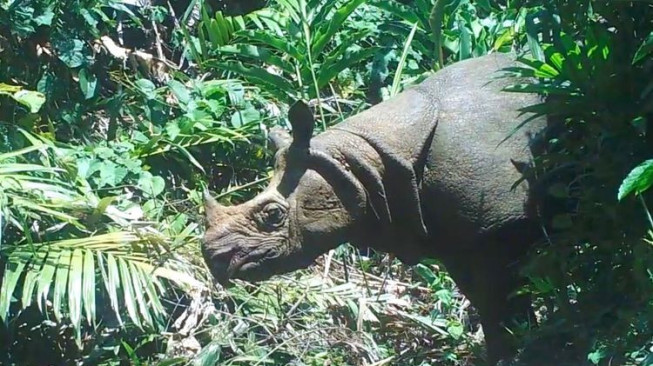
Plans to relocate some Javan rhinos (Rhinoceros sondaicus) from Ujung Kulon National Park in Banten to Alas Purwo National Park in East Java could help reduce the species’ risk of extinction. However, moving a species with only around 80–100 individuals remaining requires rigorous scientific assessment and careful preparation.
Prof Ronny Rachman Noor, an ecological genetics expert at IPB University, said that establishing a second population could, in theory, reduce the risk of extinction if a major disaster were to strike the Javan rhino’s primary habitat.
At present, all the world’s remaining Javan rhinos live in Ujung Kulon National Park. Their dependence on a single location leaves the species vulnerable to threats that could affect the entire population at once, including disease outbreaks, a tsunami in the Sunda Strait, earthquakes and sudden volcanic activity.
“In modern conservation, a backup population reduces the risk of extinction caused by disasters. The principle is simple: don’t put all your eggs in one basket,” Ronny said.
However, he warned that relocating an endangered species is far more complicated than simply moving animals from one location to another. Javan rhinos have undergone a long process of adaptation to the ecological conditions of Ujung Kulon.
“In conservation biology, relocating an endangered animal is not simply a matter of moving individuals between locations or livestock between enclosures. Javan rhinos have evolved and adapted, developing ecological relationships with their environment over hundreds or even thousands of years,” he said.
The Javan Rhino’s Long Adaptation to Ujung Kulon
According to Ronny, the Javan rhino’s adaptation has been shaped by prolonged interaction with the environment in Ujung Kulon, including its vegetation, rainfall, humidity, topography, water sources and microorganisms.
These adaptations have influenced the rhinos’ diets, feeding habits, habitat preferences, activity patterns and reproductive strategies.
For this reason, the suitability of Alas Purwo as a second habitat cannot be assessed solely on the basis of its size or forest cover. Food availability, habitat quality, environmental carrying capacity and the needs of rhinos at every stage of life must also be taken into account.
“Alas Purwo and Ujung Kulon are both forests, but they could feel very different to a rhino, much like the difference between living in Jakarta and in the middle of a forest in Kalimantan,” he said.
Differences in food plants, soil mineral composition, microorganisms, humidity and vegetation structure could all affect the animals’ ability to adapt to a new environment.
Such changes could also disrupt homeostasis, the body's ability to maintain stable internal conditions. Relocated rhinos would need to readjust their bodily systems to the temperature, humidity, water quality and seasonal patterns of their new habitat.
Ronny explained that this adaptation process could cause prolonged stress and increase levels of the hormone cortisol. If sustained, this could affect appetite, immune function, growth and reproduction.
“Readjustment is often difficult. Animals that appear healthy after relocation may only show signs of chronic stress months or even years later, for example through declining birth rates and reproductive success,” he explained.
The risks are particularly serious given the small size of the Javan rhino population. Reproductive failure among just a few individuals could affect the species’ long-term survival prospects.
Capture and Transport Pose Significant Risks
In addition to habitat adaptation, the capture and transport stages are also major concerns. According to Ronny, these stages can be among the most dangerous parts of relocating large animals.
Capture, sedation, physical handling, transfer to transport crates and journeys by land or sea can all cause severe stress.
One potential threat is capture myopathy, a condition caused by extreme stress and physical exertion that can damage muscle tissue. It can lead to respiratory problems, kidney failure and even sudden death.
“Given how few Javan rhinos remain, the death of a single adult could be a major setback for national conservation efforts. One animal represents around one per cent of the world’s population, and an adult female could become a mother to the next generation. Relocation must therefore follow strict risk-mitigation protocols. It must not be treated as an experiment,” he stressed.
Disease Risks and Competition with Other Wildlife
Another concern is the potential exposure to diseases in the new habitat. Rhinos that have lived in Ujung Kulon may not have immunity to pathogens found in Alas Purwo.
Ronny said that wildlife health surveys, epidemiological assessments and long-term monitoring would be necessary before any relocation took place. Potential interactions with domestic animals and wild species that carry diseases must also be considered.
Beyond disease, the presence of other wildlife in Alas Purwo could lead to competition for space and food. Javan rhinos would have to adapt to an animal community that has already established itself in the area.
“Alas Purwo already has its own wildlife, while the rhinos would be newcomers. We need data to determine whether they can adapt, whether they might lose out in competition, or whether they could disrupt local wildlife. We must not rely on assumptions,” Ronny said.
He emphasised that establishing a second population remains an important option for reducing the risk of extinction. However, any relocation decision must be based on comprehensive assessments covering genetics, ecology, animal health, behaviour and welfare.
For a species with only one remaining population in the world, conservation success cannot be measured simply by whether individual animals are successfully moved. The priority must be ensuring that the new population can survive and reproduce without creating risks that could further threaten the Javan rhino’s future.