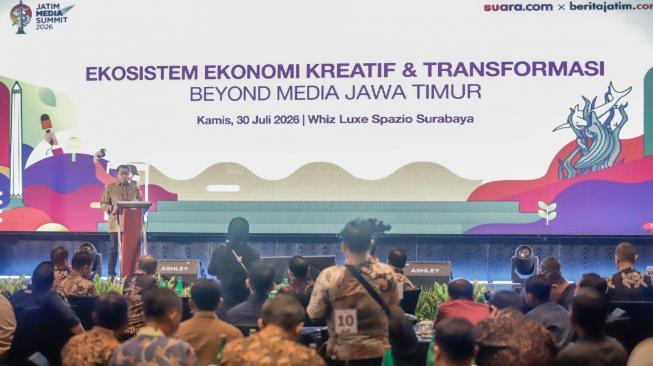
TheIndonesia.co - More than a discussion on the future of journalism, Jatim Media Summit (JMS) 2026 brought together government leaders, media executives, academics and creative industry practitioners to explore how East Java can strengthen its creative economy while preparing the media industry for the age of artificial intelligence (AI).
Held at Whiz Luxe Hotel Spazio, Surabaya, the annual summit carried the theme "Creative Economy Ecosystem and Beyond Media Transformation in East Java", highlighting the urgent need for new business models, cross-sector collaboration, and greater public trust amid AI disruption and the decline of conventional digital advertising.
East Java Positioned as Indonesia's Creative Economy Powerhouse
Opening the summit, Indonesia's Minister of Creative Economy, Teuku Riefky Harsya, said East Java possesses strong foundations to become one of the country's leading creative economy hubs.
He highlighted the rapid growth of sectors including fashion, culinary arts, crafts, gaming, film, music and digital applications, supported by a growing number of local brands capable of competing internationally.
The Minister also stressed the importance of strengthening talent development, data-driven research and intellectual property protection. He revealed that the Government is finalising Presidential Regulations on the National AI Roadmap and AI Ethics, expected to be issued within the next one to two months, to ensure AI enhances—rather than replaces—human creativity.
Media Must Move Beyond Traffic-Based Business Models
East Java Provincial Secretary Adhy Karyono emphasised that while AI enables faster information flows, it cannot replace journalists' role in verification and fact-checking.
He noted that East Java has established a dedicated Department of Culture, Tourism and Creative Economy to support the province's 5.96 per cent economic growth while encouraging digital media to become an integral part of the creative economy.
"Success in today's media landscape is no longer measured by speed alone. It is built on accuracy, responsibility and, ultimately, public trust," he said.
Echoing this sentiment, Suara.com Editor-in-Chief Suwarjono revealed that national media outlets have experienced traffic declines of between 40 and 46 per cent over the past year due to shifting global algorithms and changing audience behaviour.
He argued that relying solely on page views and digital advertising is no longer sustainable.
"Media organisations are no longer simply selling news. They must evolve into integrated ecosystems combining journalism, multimedia, communities and creative businesses," he said.
He also encouraged media organisations to diversify into communication consultancy, community management, creative content production and Generative Engine Optimisation (GEO) to ensure trustworthy journalism remains visible in AI-powered search environments.
Building a Regional Creative Media Ecosystem
The summit's first panel explored opportunities for strengthening East Java's media and creative industries through regional collaboration.
Speakers—including ICCN Executive Chair Vicky Arief Herinadharma, Suwarjono, and Singhasari Special Economic Zone CEO David Santoso—proposed the establishment of the East Java Creative Media Collective, aimed at integrating content production, events and local intellectual property development.
David Santoso also outlined Singhasari SEZ's ambition to become Indonesia's creative economy industrial hub through partnerships with King's College London, Hello Motion High School, and the planned Mumbai–Malang Creative Tech Corridor, supporting film, animation and creative technology industries.
Trust Becomes Media's Most Valuable Asset
The second session focused on business transformation in the media sector.
Suara Surabaya broadcaster Hendra Hutagalung argued that the media industry is not facing a crisis but rather a necessary evolution of its business model through diversified revenue streams and stronger public trust.
Meanwhile, BlokBojonegoro founder Abdul Qohar likened journalism to a "warship" that requires a "merchant ship"—supporting business units—to sustain quality reporting.
Representing the financial sector, Bank Jago Corporate Communication Lead Marchelo highlighted the importance of ecosystem partnerships and financial literacy in creating resilient media businesses.
The summit concluded with discussions on AI, digital literacy and misinformation.
East Java's Head of Communication and Information Office Sherlita Ratna Dewi Agustin noted that internet penetration in the province has reached 83.41 per cent, driven largely by Millennials and Generation Z. In response, the provincial government has launched programmes including CERDIK Digital Literacy and the AI Talent Factory to prepare future digital talent.
Professor Martadi from Universitas Negeri Surabaya warned of the growing challenges posed by the post-truth era and called for permanent collaboration between universities, government and media to translate academic research into accessible public knowledge.
Closing the summit, KapanLagi Youniverse Chief Content Officer Wensesiaus Manggut described AI as an opportunity for journalism to return to its core values.
"AI should become journalism's way home—bringing the industry back to quality, independence and trust, rather than chasing impressions alone," he said.
Jatim Media Summit 2026 was organised by Suara.com, Beritajatim, and International Media Support (IMS).
The event was supported by government institutions, media organisations, financial institutions, energy companies, and private sector partners committed to strengthening Indonesia's creative economy and sustainable media ecosystem.
Latest news
Former BI Governor Perry Warjiyo May Be Questioned in Corruption Inquiry

Prabowo defends criticism of media, says Indonesia still has a 'Londo Ireng' mentality
Why Do Food Poisoning Cases Keep Happening in Indonesia's Free Meals Programme?
Former National Nutrition Agency Chief Resigns as Suspect's Lawyer Calls for Investigation