TheIndonesia.co - A classified United States defence document has reportedly revealed Washington’s strategic plan to secure blanket overflight access for its military aircraft across Indonesian sovereign airspace.
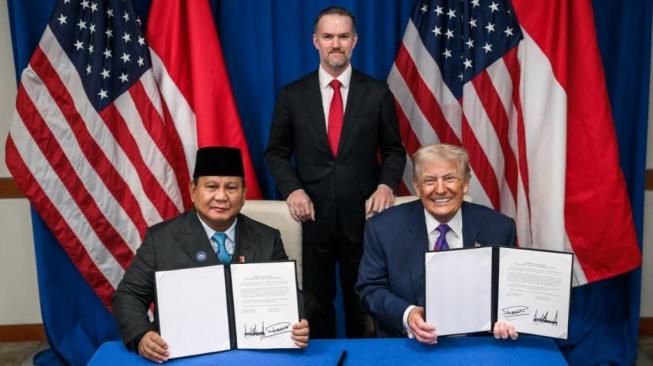
The move is said to follow a high-level meeting between Indonesian President Prabowo Subianto and US President Donald Trump in Washington last February, signalling a significant shift in the operational reach of the US military in the Indo-Pacific region.
Prabowo visited Washington, D.C. from 18 to 20 February 2026 to attend the Board of Peace Summit. According to details outlined in the leaked document, he is understood to have given preliminary approval to a proposal allowing comprehensive overflight clearance for US air assets during a bilateral meeting with Trump.
As reported by Sunny Guardian Live, the US Department of War subsequently sent a document titled “Operationalising U.S. Overflight” to Indonesia’s Ministry of Defence on 26 February 2026 to formalise the political commitment.
The document proposes a formal arrangement under which Indonesia would grant US military aircraft permission to transit its airspace for contingency operations, crisis response missions, and jointly agreed military exercises.
It explicitly states that “the Government of Indonesia will grant blanket overflight clearance for US aircraft for contingency operations, crisis response, and mutually agreed training activities”.
Further provisions indicate that US aircraft would be allowed to transit with prior notification, rather than seeking case-by-case approval, unless otherwise revoked by US authorities. This mechanism would effectively establish continuous access for US military operations once activated.
One of the most significant elements of the proposal is the shift from a layered approval system to a notification-based framework, substantially reducing procedural barriers for US military mobility in the region.
The document also outlines technical coordination measures, including the establishment of a direct hotline between the U.S. Pacific Air Forces and Indonesia’s air operations command, alongside existing diplomatic and military communication channels.
Reports suggest that Indonesia and the United States have reached consensus on the draft agreement. Indonesian Defence Minister Sjafrie Sjamsoeddin is scheduled to travel to Washington on 15 April, where he is expected to sign the formal agreement with US Defence Secretary Pete Hegseth.
As of publication, neither the US State Department, the US Department of War, nor Indonesia’s Ministry of Foreign Affairs has issued an official response regarding the leaked document.
Nevertheless, the development signals a growing US effort to secure reliable transit corridors in Southeast Asia. Indonesia’s geographical position—spanning critical sea and air routes between the Pacific and Indian Oceans—makes its airspace strategically vital for rapid deployment and military power projection.
In the Indo-Pacific, the United States already maintains base access and overflight arrangements with key allies such as Australia, the Philippines, and Japan. Indonesia’s inclusion would significantly expand US operational continuity in the region.
However, the plan is expected to trigger broader geopolitical ramifications. Granting standing access through Indonesian airspace could alter the balance of military mobility in Southeast Asia and heighten strategic tensions amid intensifying great power competition in the Indo-Pacific.
While there has been no official confirmation from either Jakarta or Washington, the sequence of events outlined in the document—including high-level political approval and an imminent signing schedule—suggests that the proposal may soon be formalised.
Disclaimer: This article is based on reports concerning a classified defence document and information circulating in international media. At the time of writing, neither the Government of Indonesia nor the United States Government has confirmed the authenticity of the document.
Latest news
Indonesian Women's Alliance says anti-LGBT policies are fuelling discrimination
Will President Prabowo Reshuffle His Cabinet in August?
Nadiem Makarim's Appeal Against Corruption Conviction to Begin on 5 August
Transfer of High-Profile Corruption Cases Raises Questions Over Legal Authority, Expert Says