


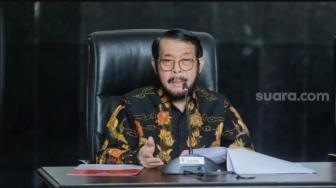
Successor to Anwar Usman Expected to Be Sworn In This Week
Regarding the inauguration schedule, Prasetyo ensured that the swearing-in process would not take long.
news

Regarding the inauguration schedule, Prasetyo ensured that the swearing-in process would not take long.

"There is still cleaning and finishing. Everything is still in good progress," President Jokowi remarked.

Jokowi affirmed that the government will continue to distribute rice to the people, depending on the capabilities of the state budget.

Indonesia’s 10th and 12th Vice President, Jusuf Kalla, has publicly expressed frustration following a series of legal and political disputes, including a police report accusing him of blasphemy and his alleged involvement in a controversy surrounding former president Joko Widodo.
Speaking at a press conference at his residence in South Jakarta on Saturday (18 April), Kalla appeared visibly agitated, stating that he had played a significant role in Widodo’s rise to power.
“I supported Jokowi. I brought him from Solo to Jakarta,” Kalla said, referring to his past political backing of Widodo.
The remarks came amid escalating tensions involving multiple legal cases. Kalla had earlier filed a police report against Rismon Sianipar, who allegedly accused him of financing Roy Suryo and others in relation to ongoing allegations about the authenticity of Widodo’s academic credentials.
The report against Rismon was registered on 8 April 2026. In response, Rismon denied the allegations, claiming that the video used as evidence was a deepfake generated using artificial intelligence.
Separately, Kalla himself has been reported to the police over alleged blasphemy. The complaint was filed on 12 April by the Gerakan Angkatan Muda Kristen Indonesia (GAMKI), alongside Pemuda Katolik and other civil society groups. The report was submitted to the Jakarta Metropolitan Police following remarks made by Kalla during a public sermon, which were deemed controversial.
Kalla suggested that the blasphemy report may be linked to his legal action against Rismon, implying a retaliatory motive.
He also revealed that he had personally advised Widodo regarding the ongoing debate over the authenticity of his academic diploma, which has sparked widespread public discussion.
“As someone older and more experienced, I felt it was my place to offer advice,” Kalla said, adding that the issue has caused significant division at the grassroots level.
Political communication analyst Hendri Satrio, known as Hensa, said Kalla’s concerns reflect broader public unease over the prolonged controversy.
“This issue has become a public concern. Why has it taken so long to resolve?” he said, pointing to calls for greater transparency.
Hensa argued that Widodo, as a former head of state, may need to take a more proactive approach to address the issue, rather than relying solely on critics to prove their claims.
Meanwhile, Arifki Chaniago, Executive Director of Aljabar Strategic Indonesia, said Kalla’s remarks about his historical role in Widodo’s political career should be seen within the context of shifting political dynamics.
“In politics, references to the past often carry present-day significance. Kalla’s statement can be interpreted as an attempt to reaffirm his historical role while maintaining relevance in current political discourse,” he said.
Arifki added that Widodo’s political success was the result of support from multiple figures, including Megawati Soekarnoputri and Prabowo Subianto, as well as broader public backing.
He noted that as Indonesia’s political landscape evolves, narratives about “who contributed to whom” are resurfacing as part of ongoing efforts by political elites to reposition themselves.
The overlapping legal disputes and political narratives underscore growing tensions among Indonesia’s political figures, as public scrutiny intensifies over both personal claims and broader questions of accountability.


