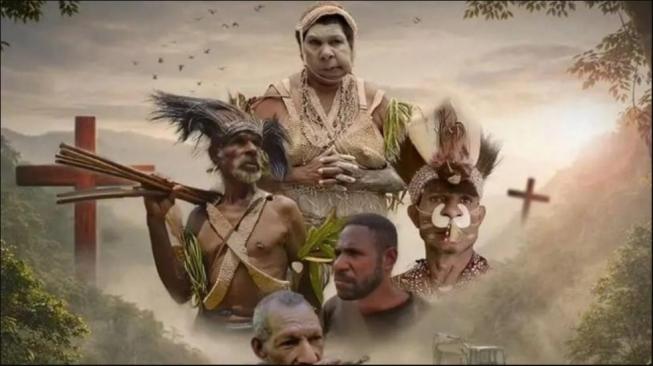
TheIndonesia.co - A documentary examining alleged land dispossession and environmental impacts linked to development projects in Papua has become the centre of a growing debate over freedom of expression in Indonesia after a series of public screenings were disrupted or cancelled across the country.
The film, Pesta Babi: Colonialism in Our Time (Pesta Babi: Kolonialisme di Zaman Kita), produced in part by Watchdoc, explores claims of customary land appropriation in South Papua allegedly connected to Indonesia’s National Strategic Projects (PSN) programme.
Since its release, the documentary has attracted significant public attention online and through community screenings. However, organisers have reported a wave of intimidation, surveillance and forced cancellations of screening events in several cities.
According to Watchdoc, at least 21 incidents of disruption were recorded between 9 April and May 2026. Reported cases included pressure on organisers to cancel events, requests for personal information, monitoring by security personnel and the forced dispersal of gatherings.
The issue has prompted criticism from human rights advocates and public figures, who argue that responses to the film should take place through open discussion rather than restrictions.
Amnesty Condemns Intimidation
The Executive Director of Amnesty International Indonesia, Usman Hamid, described the reported disruptions as an attempt to silence critical discussions about Papua.
“This is clearly an effort to silence and suppress critical voices about Papua conveyed through the film Pesta Babi,” Hamid said in a statement on Friday.
He argued that documentary films play an important role in raising public awareness of human rights and environmental issues and warned that restricting access to such information risks narrowing public debate.
“Restrictions on information about Papua make the region appear to be a taboo subject that cannot be discussed openly in Indonesia or internationally,” he said.
Amnesty International Indonesia stated that intimidation linked to the documentary’s screenings had continued from April through May, with the latest reported incidents occurring in Bekasi and Bogor.
Hamid said the reports reflected a broader failure to safeguard freedom of expression and peaceful assembly.
“Intimidation ranging from intelligence surveillance and threats against organisers to forced dispersals demonstrates that cultural and educational spaces are increasingly surrounded by fear and censorship,” he said.
He also questioned reports of military involvement in the disruption of civilian events, arguing that such actions would be inconsistent with the role assigned to the armed forces under Indonesian law.
Amnesty has called on the government, security agencies and university authorities to uphold freedom of expression, academic freedom and the public’s right to information.
“The role of authorities should be to ensure that peaceful discussions can take place safely, not to become actors in suppressing them without substantial justification,” Hamid added.
Former Minister Calls for Dialogue
Criticism of the disruptions has also come from former Religious Affairs Minister Lukman Hakim Saifuddin, who urged a more democratic response to controversial artistic works.
Speaking after attending an event organised by Kongres Ulama Perempuan Indonesia in Central Jakarta on Sunday, Lukman said disagreement with a film’s content should not be met with repressive measures.
He noted that state policies, including major development projects, should be scrutinised to ensure they do not adversely affect local communities, particularly Indigenous peoples.
“Violence can also be committed by the state. National Strategic Projects, for example, should not result in harm, especially to Indigenous communities,” he said.
Lukman argued that documentary films provide information and educational value to the public, and that restricting access to them does little to strengthen public understanding.
“Every film or work of art will naturally generate both support and criticism. But these works also educate because they provide information,” he said.
Rather than banning or disrupting screenings, Lukman encouraged those who disagree with the documentary’s arguments to respond through intellectual debate or alternative creative works.
“Those who disagree with the content of a film should respond by producing another work of art or offering a different perspective. That is how healthy public dialogue develops,” he said.
According to Lukman, open discussion allows citizens to evaluate competing claims and reach their own conclusions based on evidence, logic and lived realities.
“It helps society learn to weigh arguments carefully and decide what is consistent with reason, logic and the realities of everyday life,” he said.
Latest news
Prabowo defends criticism of media, says Indonesia still has a 'Londo Ireng' mentality
Why Do Food Poisoning Cases Keep Happening in Indonesia's Free Meals Programme?
Former National Nutrition Agency Chief Resigns as Suspect's Lawyer Calls for Investigation
Indonesian Women's Alliance says anti-LGBT policies are fuelling discrimination