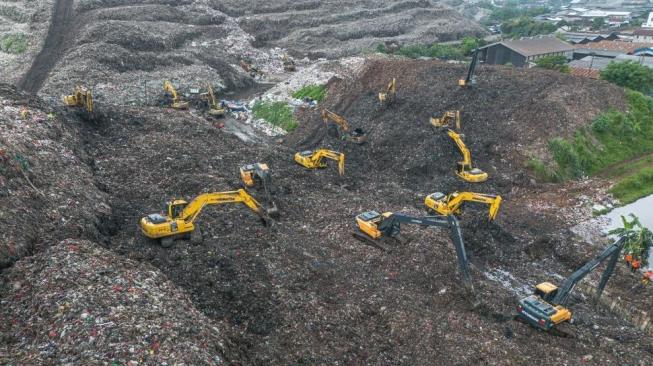
TheIndonesia.co - For over 37 years, the Bantargebang Integrated Waste Treatment Area (TPST) has silently swallowed the daily excesses of Jakarta’s 11 million residents. But on a rain-soaked Sunday afternoon, the towering, 73-meter-high mountain of garbage finally gave way, turning decades of municipal waste into a deadly avalanche.
The tragedy, which claimed seven lives, has sent shockwaves through the capital's corridors of power, serving as a grim wake-up call. For Minister of Environment Hanif Faisol Nurofiq, the disaster is not just an accident; it is the inevitable breaking point of a flawed system.
"This must be the turning point for our waste management," Hanif declared with palpable urgency following a communal clean-up effort at Kramat Jati Market in East Jakarta on Wednesday (11/3/2026).
The statistics surrounding Bantargebang are staggering. According to Ministry records, the sprawling site currently holds more than 80 million tons of refuse. The landscape is dominated by colossal, man-made mountains—inactive zones cresting at 50 meters, while active dumping zones scrape the sky at an imposing 73 meters.
"It is a highly dangerous condition," Hanif noted.
Nature, it seems, provided the final push. Following nearly twelve hours of torrential weekend rain, the waterlogged waste became structurally compromised. Just hours after the rain ceased on Sunday, March 8, the mountain collapsed in Zone 4 at 14:30 WIB, burying workers and scavengers below.
By the time the Head of the Jakarta Search and Rescue (SAR) Office, Desiana Kartika Bahari, officially closed the rescue operations at midnight on Monday, the human toll was finalized: out of 13 victims pulled from the wreckage, six survived, and seven perished.
The End of "Open Dumping"
For Minister Hanif, the Bantargebang landslide evokes painful memories of the 2005 Leuwigajah disaster in Cimahi, where a similar trash avalanche killed 157 people. To prevent history from repeating itself, he is drawing a hard line.
"Systematically and structurally, we must end the practice of open dumping at Bantargebang," he asserted. The primitive method of piling raw garbage into the open air, he argued, has caused severe environmental degradation and has now culminated in an unforgivable loss of life.
However, dismantling a mountain requires addressing the source. Jakarta generates a staggering 8,000 tons of waste every single day. Of that, roughly 1,000 tons pour in from commercial hubs—markets, hotels, restaurants, and transit stations.
Hanif is calling for a radical shift in responsibility. Commercial zones must begin managing their own waste, while households are being urged to rigorously sort their trash to drastically reduce the volume sent to landfills. The government is also pushing to maximize existing waste-to-energy plants and Refuse Derived Fuel (RDF) facilities in Rorotan and Bantargebang.
This sentiment is strongly echoed in the city's parliament. Yuke Yurike, Chair of Commission D of the Jakarta City Council, is pressing for an immediate acceleration of independent waste management in the city's bustling traditional markets.
Kramat Jati Market, a massive generator of organic waste, is prime for this intervention. "Whether it is managed independently by Pasar Jaya, jointly with the Environment Agency, or through private sector investment, the most important thing is that it must be handled immediately," Yuke stated.
As the heavy machinery clears the debris at Zone 4 and the grieving families bury their dead, the towering shadow of Bantargebang remains. The tragedy has proven that out of sight can no longer mean out of mind. For Jakarta, the era of blindly tossing away its problems has come to a fatal, tragic end.
Latest news
Former BI Governor Perry Warjiyo May Be Questioned in Corruption Inquiry

Prabowo defends criticism of media, says Indonesia still has a 'Londo Ireng' mentality
Why Do Food Poisoning Cases Keep Happening in Indonesia's Free Meals Programme?

Former National Nutrition Agency Chief Resigns as Suspect's Lawyer Calls for Investigation