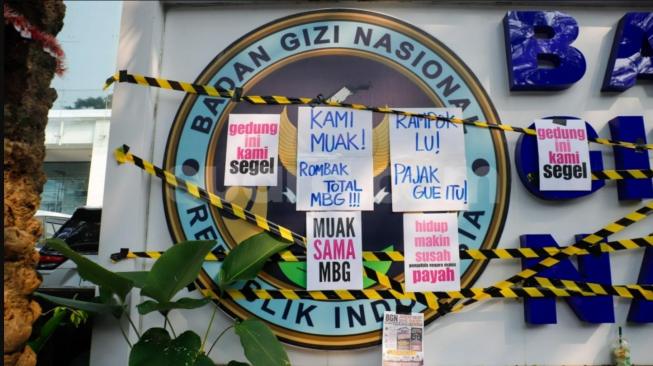
TheIndonesia.co - The Indonesian Education Monitoring Network (JPPI) has argued that the government's Free Nutritious Meals (MBG) programme is one of the reasons efforts to improve teachers' welfare have stalled.
The organisation claims that education funds originally intended to improve the quality of education are instead being diverted to finance the government's flagship programme.
JPPI Advocacy Coordinator Ari Hardianto made the remarks in response to President Prabowo Subianto's speech at the closing of the Nahdlatul Ulama (NU) National Congress in Bangkalan, East Java, where the president said that teachers' welfare problems were not caused by a lack of education funding but by leakage in state revenues.
"If there is no money left for teachers' welfare because it has been taken away, perhaps the President does not know who took it. We can tell him: it is the MBG programme. It is taking money from the education budget, reducing the allocation and ultimately depriving teachers and other education workers of their rights," Ari told Suara.com on Wednesday (1 July).
According to Ari, the government's proposed MBG budget ceiling of Rp270 trillion (£12.3 billion) for 2027 could place even greater pressure on Indonesia's constitutionally mandated education budget, which must account for at least 20% of the state budget (APBN).
"That shows the President actually knows where the money has gone. The 20% education allocation in the state budget is supposed to be used solely for education functions," he said.
JPPI argues that education spending should prioritise four key areas: curriculum and teaching development, improving teachers' welfare, ensuring students have access to free education, and providing adequate educational infrastructure.
Ari therefore believes using education funds to finance MBG has shifted spending away from those priorities.
"The President's speech before NU clerics illustrated a major contradiction. People in Islamic boarding schools understand that he knows, but acts as if he doesn't know. It's an anomaly," Ari said.
Education Transfers to Regions Have Fallen
JPPI also claims that diverting education funds to MBG is beginning to affect local governments, particularly their ability to pay honorary teachers and civil-service contract teachers (PPPK) as transfers for education decline.
According to Ari, central government education transfers to regional administrations amounted to Rp347 trillion in 2025 but fell to Rp264 trillion in 2026.
He also criticised the fact that around 20 ministries and state agencies that are not directly responsible for education still receive a share of the constitutionally mandated education budget.
In his view, this contradicts Indonesia's National Education System Law (Law No. 20 of 2003).
"Since the MBG programme was first proposed, JPPI has repeatedly warned against placing it under the education budget. At the time, the government insisted it wasn't using education funds. But now it has effectively admitted that it is," he said.
Despite the criticism, JPPI welcomed the government's decision to begin evaluating the implementation of the MBG programme. However, Ari stressed that the review should be followed by ending the use of education funds to finance the scheme.
Regarding the ongoing constitutional challenge at the Constitutional Court over the use of education funds for MBG, Ari expressed hope that the court would uphold the constitutional requirement that education funding be used exclusively for educational purposes.
"The Constitutional Court has an opportunity to safeguard children's right to education from being taken away by other programmes," he said.
Latest news

MMA Indonesia: Strong leadership, not AI alone, will shape the next generation of brands

Creative Economy Minister Backs Jatim Media Summit 2026 to Empower Local Media

Jokowis Moves Fuel Speculation Over Another PrabowoGibran Run in 2029
Former National Nutrition Agency Deputy Denied Justice Collaborator Status in MBG Graft Case